Effect of Head-Slaved Visual Image Roll on Spatial Situation Awareness
Abstract
We examined whether the inclusion of head-slaved "roll", in addition to pitch and yaw degrees of freedom (DOF), to control the orientation of a remotely-viewed or computer-synthesized scene can enhance spatial situation awareness.
Six subjects were required to match the position and orientation of stationary target markers on a remote taskboard by manually placing response markers on an identical local taskboard. Subjects could only view the remote taskboard through images transmitted to a head mounted display (HMD) from a motorized pitch-yaw-roll camera platform; they could see neither the local taskboard nor their own limbs.
Results show that, while systematic overestimation errors in azimuth occurred regardless of the roll condition, the addition of the roll DOF to the platform had no statistically discernible effect on the subjects' ability to match the position (i.e., azimuth and elevation) of the remote targets. Absence of the roll DOF, however, did affect the subjects' judgment of orientation when their heads were at maximum elevation (pitch) and azimuth (yaw) combinations.




















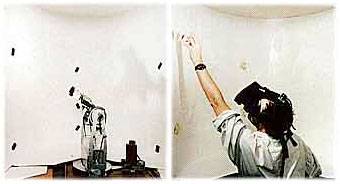 We examined whether the inclusion of head-slaved "roll", in addition to pitch and yaw degrees of freedom (DOF), to control the orientation of a remotely-viewed or computer-synthesized scene can enhance spatial situation awareness.