|
|
 |

|
|
|
| Virtual Modeling in Acoustic Environments |
|
|
Principal Investigator
Elizabeth M. Wenzel
Abstract
An important improvement for laboratory acoustic and psychoacoustic analysis is the ability to accurately measure an acoustical environment. Accurate acoustic measurements enable mathematical analysis relevant to flight human factors, and allows the ability to place a listener in an acoustical space by listening over headphones. This technique is called auralization: the process of rendering audible, by physical or mathematical modeling, the sound field of a source in a space, in such a way as to simulate the binaural listening experience at a given position.
A properly designed auralization system can let an acoustical consultant, human factors engineer or their customer listen to and compare the effect of different acoustical treatments or architectural designs, both for existing rooms and for those still in the conceptual design phase. The specific objective of the technology developed at Ames is to more accurately measure the spatial reverberation "thumbprint" of existing acoustical spaces, known as the room impulse response. Proper measurement of the room impulse responses yields an analytic signal of an existing room that allows both laboratory analysis of the space, and synthesis of that space within a virtual acoustic environment.
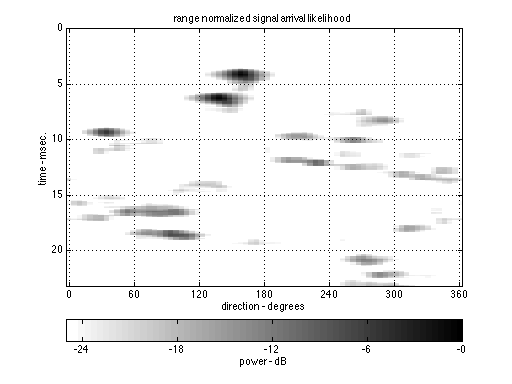
Specifically, a special microphone array is used to detect and determine the direction of arrival of reflected energy in order to characterize the spatial nature of room reverberation. Two mathematical techniques, known as maximum likelihood estimation and likelihood ratio detection, provide significantly greater spatial resolution by taking advantage of measurements from multiple microphone measurement positions. Figure 1 shows the acoustical thumbprint of a hallway's many reflections.
|
|
|
|
|