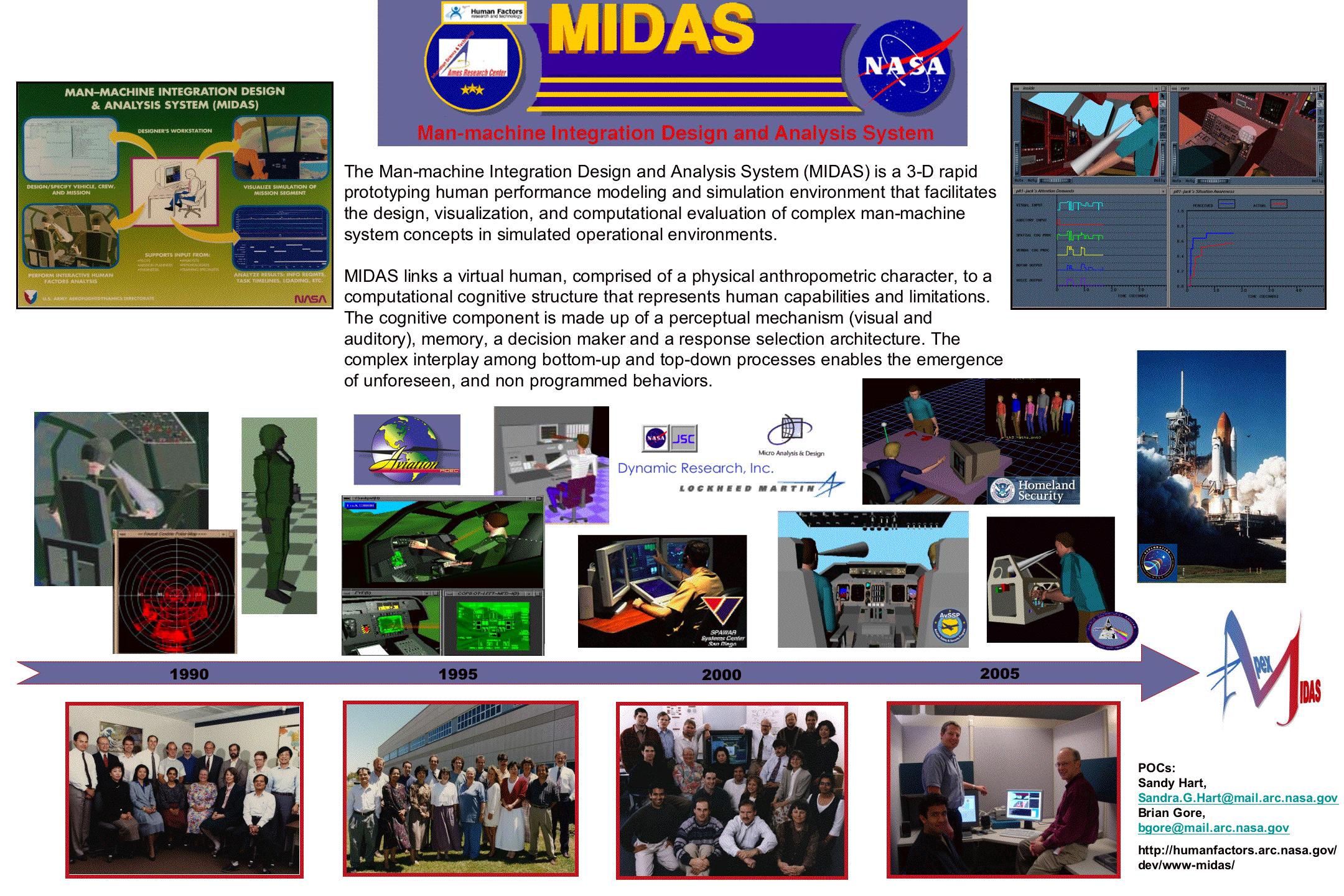
| |
Publications
 Download Adobe Acrobat Reader Download Adobe Acrobat Reader
B. L. Hooey, B. F. Gore, E. A. Mahlstedt, & D. C. Foyle (2013) Evaluating NextGen Closely Spaced Parallel Operations concepts with validated human performance models: Flight deck guidelines, NASA TM-2013-216506. Moffett Field, CA: NASA Ames Research Center. ( - PDF
1.4 MB) - PDF
1.4 MB)
B. F. Gore, B. L. Hooey, E. A. Mahlstedt, & D. C. Foyle (2013) Evaluating NextGen Closely Spaced Parallel Operations concepts with validated human performance models: Scenario development and results, NASA TM-2013-216503. Moffett Field, CA: NASA Ames Research Center. ( - PDF
3 MB)
Hooey, B.L., Gore, B.F., Mahlstedt, E., & Foyle, D.C. (2012). Evaluating NextGen Closely Spaced Parallel Approach Concepts with Validated Human Performance Models Flight Deck Guidelines (Part 1 of 2), In Human Centered Systems Lab (Ed.), HCSL Technical Report. Moffett Field, CA: NASA Ames Research Center. ( - PDF
1.4 MB)
Gore, B.F., Hooey, B.L., Mahlstedt, E., & Foyle, D.C. (2012). Evaluating NextGen Closely Spaced Parallel Approach Concepts with Validated Human Performance Models Flight Deck Guidelines (Part 2 of 2), In Human Centered Systems Lab (Ed.), HCSL Technical Report. Moffett Field, CA: NASA Ames Research Center. ( - PDF
3 MB)
Gore, B.F., Hooey, B.L., Mahlstedt, E., & Foyle, D.C. (2012). Extending validated human performance models to explore NextGen Concepts. In the 4th International Conference on Applied Human Factors and Ergonomics (AHFE), July 2012. ( - PDF
476 KB)
Wickens, C.D., Sebok, A., Gore, B.F., & Hooey, B.L. (2012). Predicting pilot error in NextGen: Pilot performance modeling and validation efforts. In the 4th International Conference on Applied Human Factors and Ergonomics (AHFE), July 2012.
Sebok, A., Wickens, C., Gacy, M., Brehon, M., Scott-Nash, S., Sarter, N., Li, H., Gore, B.F., & Hooey, B.L. MIDAS-FAST: A modeling and simulation-based tool to predict operator performance in human-robotic automation systems. In the 4th International Conference on Applied Human Factors and Ergonomics (AHFE), July 2012.
Gore, B. F., Hooey, B. L., Haan, N., Bakowski, D. L., & Mahlsted, E. (2011, July 9 - July 14). A methodical approach for developing valid human performance models of flight deck operations. Paper presented at the 14th Annual HCI International 2011, Orlando, FL. ( - PDF
1.1 MB)
Gore, B.F. (2011, March 23). Workload as a Performance Shaping Factor
for Human Performance Models. Symposium presented at the Behavioral
Representation in Modeling and Simulation (BRIMS) 2011, Sundance, Utah. ( - PDF
120 KB)
Gore, B.F., Hooey, B.L., Wickens, C.D., Socash, C., Gosakan, M.,
Gacy, A.M., Brehon, M., & Foyle, D.C. (2011, March 23). Workload as a
performance shaping factor in MIDAS v5. Presented at the Behavioral
Representation in Modeling and Simulation (BRIMS) 2011, Sundance, UT. ( - PDF
1.8 MB)
Gore, B.F., Hooey, B.L., & Foyle, D.C. (2011, March 21-24). NASA's
use of human performance models for NextGen concept development and
evaluation. Paper to be presented at the Behavioral Representation in
Modeling and Simulation (BRIMS) 2011, Sundance, UT.
( - PDF
216 KB)
Gore, B.F., Hooey, B.L., Socash, C.M., Haan, N. J., Mahlstedt, E., Bakowski,
D.L., Gacy, A.M., Wickens, C.D., Gosakan, M., and Foyle, D.C. (2011).
Evaluating NextGen closely space parallel operations concepts with validated
human performance models. HCSL Technical Report (HCSL-11-01). Human Centered
Systems Laboratory (HCSL), Moffett Field, CA: NASA Ames Research Center.
( - PDF
2.1 MB)
Gore, B.F., Hooey, B.L., Wickens, C.D., Sebok, A., Hutchins, S., Salud, E., Small, R., Koenecke, C., & Bzostek, J. (2010). Identification of pilot performance parameters for human performance models of off-nominal events in the NextGen environment (NASA/CR # 2010-216411). Washington, D.C.: National Aeronautics and Space Administration. ( - PDF
3.9 MB)
Gore, B. F. (2010). Man-machine integration design and analysis system (MIDAS) v5: Augmentations, motivations, and directions for aeronautics
applications. In P. C. Cacciabu, M. Hjalmdahl, A. Luedtke and C. Riccioli (eds.) Human Modelling in Assisted Transportation. Heidelberg, Springer-Verlag Berlin Heidelberg. ( - PDF
400
KB)
Hooey, B. L., B. F. Gore, Wickens, C.D., Scott-Nash, S., Socash, C., & Salud, E. (2010). Modeling Pilot Situation Awareness. In P. C. Cacciabu, M. Hjalmdahl, A. Luedtke and C. Riccioli (eds.) Human Modelling of Assisted Technologies. Begirate, Italy, Springer-Verlag Berlin Heidelberg. ( - PDF
640
KB)
Gore, B. F. (2010). The use of behavior models for predicting complex operations. Behavioral Representation in Modeling and Simulation (BRIMS) 2010. Charleston, South Carolina, Simulation Interoperability Standards Organization (SISO): 1-4. ( - PDF
284
KB)
Gore, B.F., Hooey, B.L., Wickens, C.D., & Scott-Nash, S. (2009). A computational implementation of a human attention guiding mechanism in MIDAS v5. In V.G. Duffy (Ed.): Digital Human Modeling, HCII 2009, LNCS 5620, pp. 237246, 2009. ( - PDF
580
KB)
Gore, B.F., Hooey, B.L., Foyle, D.C., & Scott-Nash, S. (2008). Meeting the challenge of cognitive human performance model interpretability though transparency: MIDAS v5.x. In the 2nd International Conference on Applied Human Factors and Ergonomics, July 14-17, Las Vegas, Nevada. (
-
PDF
2.8
MB)
Boring, R.L. Gertman, D.I, Tran, T.Q., & Gore, B.F. (2008). Framework and application for modeling control room crew performance at nuclear powerplants. In the 52nd Annual Human Factors and Ergonomics Annual Meeting, September 22-26, NY, NY. (
-
PDF
940 KB)
Gore, B.F. & Smith, J.D. (2006). Risk assessment and human performance modeling: the need for an integrated approach. In K.A. Malek (ed.) International Journal of Human Factors of Modeling and Simulation, 1(1), 119-139.
Gore, B.F., & Jarvis, P.A. (2006). New integrated modeling capabilities: MIDASí recent behavioral enhancements. SAE Transactions - Journal of Passenger Cars Electronic and Electrical Systems, Warrendale: SAE, Inc.
Gore, B.F. & Milgram, P. (2006). The conceptual development of a time estimation model to predict human performance in complex environments. Ninth Proceedings of the Annual SAE International Conference and Exposition - Digital Human Modeling for Design and Engineering Conference, SAE Paper # 2006-01-2344, Warrendale: USA, July.
Boring, R.L., Dudenhoeffer, D.D., Hallbert, B.P., & Gore, B.F. (2006). Virtual power plant control room and crew modeling using MIDAS. Proceedings of the Joint Halden Reactor Project and CSNI Special Expertsí Group on Human and Organisational Factors Workshop on Future Control Station Designs and Human Performance Issues in Nuclear Power Plants, May 8 10, 2006, Halden, Norway, pp. 1 5:5.3.
Gore, B.F., & Jarvis, P. (2005). Modeling the complexities of human performance. 2005 IEEE International Conference on Systems, Man, and Cybernetics, IEEE Catalogue #: 05CH37706C, ISBN 0-7803-9299-X, USA: IEEE Systems, Man and Cybernetics Society.
(
-
PDF
1.2
MB)
Gore, B.F., & Jarvis, P.A. (2005). New integrated modeling capabilities: MIDAS‚ recent behavioral enhancements. Eighth Proceeding of the Annual SAE International Conference and Exposition - Digital Human Modeling for Design and Engineering, SAE Paper #2005-01-2701, Warrendale: USA, June.
(
-
PDF
156
KB)
Smith,
J.D.,
Gore,
B.F.,
Dalal,
K.M.,
&
Boyle,
R.
(2002).
Optimizing
biology
research
tasks
in
space
using
human
performance
modeling
and
virtual
reality
simulation
systems
here
on
Earth.
In
32nd
International
Conference
on
Environmental
Systems
(ICES),
July
15-18,
San
Antonio
TX
(SAE
paper
02ICES-307).
(
-
PDF
712
KB
)
Gore, B.F. (2002). Human performance cognitive-behavioral modeling: A benefit for occupational safety. In B. Chase & W. Karwowski (Eds.), International Journal of Occupational Safety and Ergonomics (JOSE), 8 (3), 339-351.
Gore, B.F., & Corker, K.M. (2001). Human error modeling predictions: Increasing occupational safety using human performance modeling tools. In B. Das, W. Karwowski, P. Modelo, and M. Mattila (eds.), Computer-Aided Ergonomics and Safety (CAES) 2001 Conference Proceedings, July 28 - August 4, Maui, Hawaii.
Gore,
B.F.,
&
Corker,
K.M.
(2001).
Human
performance
modeling:
A
cooperative
and
necessary
methodology
for
studying
occupational
ergonomics.
In
International
Society
for
Occupational
Ergonomics
and
Safety
(ISOES)
2001
Conference,
June
4
-
7,
Fairfax,
Virginia.
(
-
PDF
475
KB)
Hart,
S.G.,
Dahn,
D.,
Atencio,
A.,
&
Dalal,
K.M.
(2001).
Evaluation
and
application
of
MIDAS
v2.0.
In
the
Proceedings
of
the
Society
of
Automtive
Engineers
(SAE)
World
Aviation
Congress,
Sept
2001,
Seattle
WA
(SAE
paper
2001-01-2648).
(
-
PDF
2.3
MB)
Abkin, Michael H., Bobick, John C., Hansmann, R. John, Reynolds, Tom G., Hansen, Mark M., Gosling, Geoffrey D., Baumgardner, William F., Corker, Kevin, & Gore, Brian. (2000). Development of fast-time simulation techniques to model safety issues in the national airspace system. NASA Ames Research Center Contract No. NAS2-99072. CY00 Final Report, December.
Burdick, M.D., & Shively, R.J. (2000). A full mission evaluation of a computational model of situation awareness. In the Proceedings of the 14th Triennial International Ergonomics Association (IEA) and the Human Factors and Ergonomics Society 44th Annual Meeting, USA ( - PDF 80KB)
Corker, K.M. & Gore, B.F. (2000). Human performance simulation in the analysis of advanced air traffic management. International Topical Meeting on Nuclear Plant Instrumentation, Controls, and Human-Machine Interface Technologies (NPIC&HMIT 2000), Washington, DC, November.
Gore, B.F. & Corker, K.M. (2000). A systems-engineering approach to behavioral prediction of an advanced air traffic management concept. 19th Annual Digital Avionics Systems Conference (DASC): Entering the Second Century of Powered Flight, 1, 4B3/1 -4B3/8.
Gore, B.F. & Corker, K.M. (2000). Value of human performance cognitive predictors: A free flight integration application.∫ Proceedings of the 14th Triennial International Ergonomics Association (IEA) and the Human Factors and Ergonomics Society 44th Annual Meeting, USA, 6, 493-496.
Gore, B.F. & Corker, K.M. (2000). Human performance modeling: Identification of critical variables for national airspace safety. Proceedings of the 14th Triennial International Ergonomics Association (IEA) and the Human Factors and Ergonomics Society 44th Annual Meeting, USA, 1, 725-728.
Gore, B.F. (2000). The study of distributed cognition in free flight: A human performance modeling tool structural comparison. Proceedings of the Third Annual SAE International Conference and Exposition - Digital Human Modeling for Design and Engineering, Dearborn, Michigan.
Tyler,
S.,
Neukom,
C.
Logan,
M.
and
Shively,
J.
(1998).
The
MIDAS
human
performance
model.
In
the
Proceedings
of
the
Human
Factors
and
Ergonomics
Society
42nd
Annual
Meeting.
Chicago,
Illinois.
pp.
320-325.
(
-
PDF
97
KB)
Smith,
B.R.,
&
Tyler,
S.W.
(1997).
The
design
and
application
of
MIDAS:
A
constructive
simulation
for
human-system
analysis.
(
-
PDF
464
KB)
Pisanich,
G.
M.,
Corker,
K.
&
Bunzo,
M.
(1997).
A
cognitive
system
model
for
human/automation
dynamics
in
airspace
management.
Presented
at
the
13th
Triennial
Conference
of
the
International
Ergonomics
Association,
Tempere,
Finland.
(
-
PDF
155
KB)
Shively,
R.J.,
Brickner,
M.,
&
Silbiger,
J.
(1997).
A
computational
model
of
situational
awareness
instantiated
in
MIDAS.
In
the
Proceedings
of
the
Ninth
International
Symposium
on
AviationPsychology
(pp.
1454-1459).
Columbus,
OH:
University
of
Ohio.
(
-
PDF
56
KB)
Shively, R.J., Brickner, M. & Silbiger, J. (1997). A Computational Model of Situational Awareness Instantiated in MIDAS. Proceedings of the Ohio State 10th International Symposium on Aviation Psychology, Columbus, Ohio. ( - PDF 56 KB)
Pisanich,
G.&
Corker,
K.
(1995).
Predictive
model
of
flight
crew
performance
in
automated
air
traffic
control
and
flight
management
operations.
In
the
Proceedings
of
the
Ohio
State
8th
International
Symposium
on
Aviation
Psychology,
Columbus,
Ohio.
(
-
PDF
60
KB)
Corker,
K.M.
&
Smith,
B.R.
(1993).
An
architecture
and
model
for
cognitive
engineering
simulation
analysis:
Application
to
advanced
aviation
automation.
In
the
Proceedings
of
the
AIAA
Computing
in
Aerospace
9
Conference.
October,
1993:
San
Diego,
CA.
(
-
PDF
72
KB)
Presentation
Slides
MIDAS Poster
MIDAS Overview - Human
Performance
Research
Laboratory
15th
Anniversary
2005 (5.6MB)
|
|