|
 |
The Airspace Operations Lab evaluates ATM concepts and explores human-system interaction issues in a simulation environment designed to allow rapid prototyping of NextGen concepts. This environment allows simulations of aircraft, ATM systems and communication infrastructure for both current day operations and a variety of future, highly automated concepts. Controller workstations are realistic emulations of today's en route, Terminal Radar Approach Control (TRACON) and oceanic systems, enhanced with various AOL-developed decision support tools and automated functions.
Our main research goal is to evaluate future ATM systems and associated human-system interactions. These findings help the ATM community to understand how these issues relate to NextGen concepts, and can lead to better understanding of roles and responsibilities for human operators and automation in future ATM systems. |
| |
 |
|
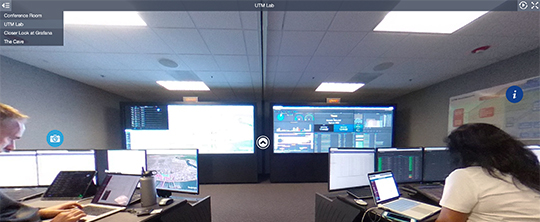
Get an inside look at the Airspace Operations Laboratory (AOL) by taking our virtual tour. Click the image below and navigate your way through the various rooms in our facility. While taking the tour, click the icons to learn about our research, view images and watch videos.
 |
| |
 |
|
 |
The AOL plays a vital role in the Advanced Air Mobility (AAM) Project’s National Campaign testing series. Building on its legacy of work in air traffic management and its role in the success of NASA’s UTM efforts, the AOL is leading the integration and testing of the AAM ecosystem that will help inform the airspace integration requirements to enable safe, efficient, and scalable AAM operation in the National Airspace System (NAS). Along with government and industry partners, the AOL team will be hosting the AAM National Campaign (NC) series and serving as the Operations Center during the NC activities. |
| |
|
 |
Along with the Department of Defense (DoD), the AOL is supporting Federal Agencies in developing a prototype Federal UAS Service Supplier (FUSS). The aim of this research is to assist in determining the functions and features needed for a Federal UAS Service Supplier (FUSS) and its requirements for integration with the UAS Traffic Management (UTM) environment. |
| |
|
 |
The High Density Vertiplex (HDV) subproject is responsible for the development and evaluation of a reference automation architecture that addresses scalable and efficient aircraft operations, flight and airspace management procedures, and vertiport operations in high density vertiplex environments. |
| |
|
 |
The Pathfinding for Airspace with Autonomous Vehicles (PAAV) project aims to develop concepts, procedures, and technology to enable airspace access for unmanned air cargo operations with targeted autonomy and integrate them with conventional aircraft in the National Airspace System (NAS). |
| |
|
 |
The AOL is applying NASA technology to improve emergency response operations. STEReO is a convergence of knowledge and technology in Unmanned Aircraft Systems (UAS) Traffic Management (UTM), Autonomy, Communications, Human Factors, and Domain Expertise & Tools, aimed at providing operational resiliency to dynamic changes during a natural disaster. |
| |
|
 |
The Supplemental Data Service Provider (SDSP) project is working to provide additional services within prototype air traffic management systems that will organize, enable and protect future airspace concepts that support safety and encompass higher levels of automation. |
| |
|
 |
Upper-Class E Traffic Management (ETM) is an airspace management concept for National Airspace System (NAS) flight operations at or above FL600. As recent advances in technologies increase the demand in the stratospheric airspace, the disparity of vehicles and the mixture of operating paradigms present new opportunities for a cooperative and interactive traffic management perspective. |